
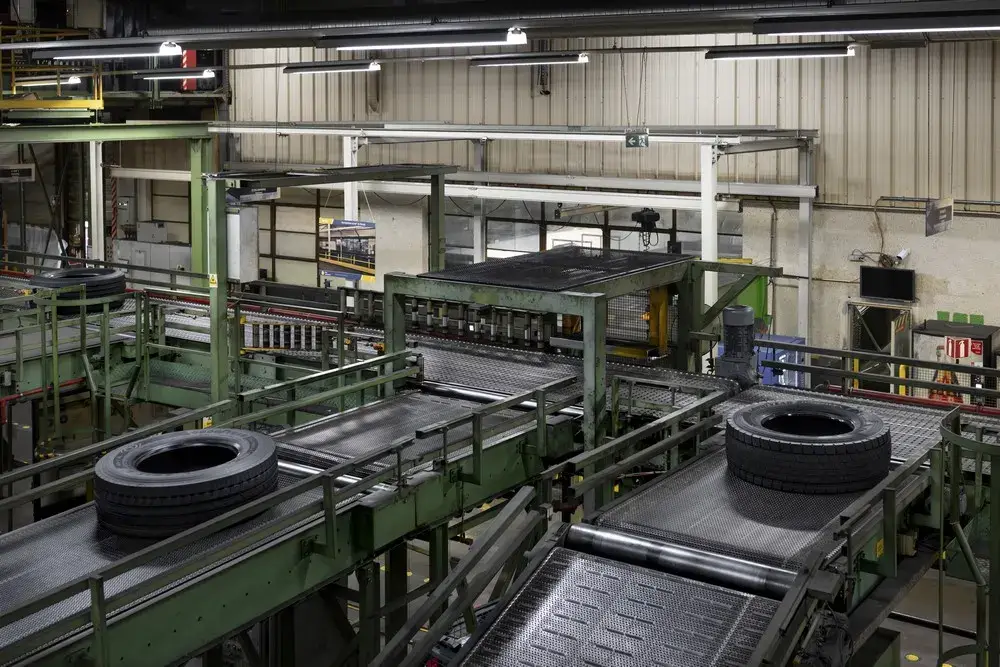
Fabriken das Nachdenken beibringen: Goodyears KI-Reise
Goodyear, einer der größten industriellen Arbeitgeber in Luxemburg, entwickelt mit LIST den Goodyear Semantic Twin Accelerator (GSTA), um seine Daten in Entscheidungen umzuwandeln.
 Laurence Kayl (Fedil)
03/11/2026
[This article is part of a content series developed in collaboration with FEDIL, showcasing how artificial intelligence is contributing to the digital transformation of Luxembourg’s economy.]
 Goodyear is one of Luxembourg’s largest industrial employers, with a long-standing presence in the country and extensive expertise in tire manufacturing. Operating highly complex production facilities, the company continuously invests in innovation to improve operational performance, quality, and sustainability.
Today, the company is taking a significant step forward in its digital transformation journey through the development of the Goodyear Semantic Twin Accelerator (GSTA), an AI-enabled platform designed to accelerate industrial decision-making and scale digital innovation across manufacturing sites.
The challenge: turning massive amounts of data into actionable knowledge
Modern tire manufacturing generates an extraordinary volume of operational data. Thousands of process variables are recorded throughout production, from raw material preparation and mixing to extrusion, assembly, logistics, and final quality control. Yet despite this abundance of information, many industrial AI projects struggle to move beyond isolated pilot initiatives.
The core issue is not the lack of data. Rather, it is the difficulty of giving that data a shared operational meaning. Information is often scattered across departments, systems, and processes, preventing teams from building a consistent end-to-end view of operations. Engineers, production specialists, quality teams, and logistics experts may interpret the same data differently, making it difficult to scale insights and replicate successful initiatives.
As a result, organisations frequently face two major obstacles: fragmented knowledge and limited trust in AI-generated recommendations. Without a common framework linking data, processes, and business objectives, advanced analytics can remain disconnected from real operational needs.
The solution: a semantic digital twin powered by AI
To address these challenges, Goodyear, in collaboration with LIST (Luxembourg Institute of Science and Technology), developed the Goodyear Semantic Twin Accelerator (GSTA). The platform combines semantic AI, knowledge graphs, and digital twin technology to create a shared digital representation of manufacturing operations.
“When talking about AI, new and future technologies come to mind. At Goodyear we want AI to improve legacy industries, to improve already existing processes,” says Luc Audibert, Senior Project Manager.
At the heart of the solution lies a semantic model that describes every relevant aspect of the factory: materials, production steps, equipment, resources, constraints, operational rules, and key performance indicators. Instead of treating process variables as isolated numbers, the system understands their role and context within the manufacturing environment.
This semantic layer serves as a common language across teams while providing an AI-ready foundation for future analytics and automation initiatives.
When talking about AI, new and future technologies come to mind. At Goodyear we want AI to improve legacy industries, to improve already existing processes. Luc Audibert, Goodyear
The solution is complemented by a discrete-event simulation engine that acts as a virtual factory. This digital twin allows teams to test "what-if" scenarios before implementing changes on the shop floor. Operational alternatives can be evaluated safely, and their impact on throughput, lead times, work-in-progress, resource utilisation, and logistics performance can be measured through consistent and explainable KPIs.
Why artificial intelligence is essential
Artificial intelligence plays a central but controlled role in the GSTA approach. Semantic technologies and knowledge graph’s structure manufacturing knowledge and make scenarios, assumptions, and results traceable. Bounded LLM assistants can support users by translating natural-language questions into structured scenario candidates and by interpreting simulation evidence. Their outputs do not directly become executable model logic or accepted conclusions: scenario proposals are checked against semantic rules, while diagnoses must remain grounded in recorded evidence.
GSTA also supports knowledge-graph-grounded design of experiments, allowing alternative configurations to be explored systematically and compared using consistent KPIs. This combination of AI assistance, deterministic simulation, and traceable evidence helps reduce the "black-box" effect while keeping decision support auditable. The same foundation can later incorporate additional capabilities such as machine learning and anomaly detection.
Creating a scalable industrial AI capability
Beyond its technical innovation, GSTA was designed with scalability in mind. The solution is being deployed for truck and bus tire production operations and has been developed to facilitate replication across multiple manufacturing sites. By standardising operational definitions, simulation models, and KPI frameworks, the platform creates reusable digital assets that reduce implementation effort and accelerate future AI initiatives.
This approach allows Goodyear to move beyond isolated pilot projects and establish a sustainable framework for industrial AI adoption. The initiative also strengthens collaboration between industrial and research partners while contributing to the development of advanced digital manufacturing skills.
Measurable impact and future potential
The prototype has already demonstrated its ability to structure complex manufacturing knowledge and deliver repeatable, traceable performance analyses across operational scenarios. According to project estimates, the approach could accelerate digitalisation and AI deployment cycles by approximately 30 to 40 percent, significantly reducing the time required to move from an operational question to a validated decision supported by reliable KPIs.
By combining semantic AI, digital twins, and explainable analytics, Goodyear is building more than a technological solution. It is creating a scalable decision-support capability that enables faster innovation, stronger operational performance, and greater confidence in the adoption of AI within industrial manufacturing