
How Luxembourg SMEs can harness AI
Artificial intelligence offers Luxembourg’s SMEs practical tools to optimise processes, automate repetitive tasks and enhance competitiveness.
 Jean-Michel Gaudron
15/04/2026
AI is now an essential element for any company seeking to improve efficiency and productivity, regardless of size.
Rather than being limited to generative AI tools, artificial intelligence should be seen as a suite of technologies enabling machines to simulate human capabilities.
These technologies serve three main objectives:
- Learning: Analysing data to identify patterns and improve outcomes
- Reasoning: Drawing conclusions from available information
- Acting: Making decisions or recommending actions autonomously
The four key steps of AI in business
Anthony Auert, Manager Mobility – Business Relationship Management, explained at the second Club Innovation of the year: “The functioning of artificial intelligence can be broken down into four key steps: data collection, through sensors or by compiling statistical or historical information; learning, via data analysis by an algorithm; creation of a predictive model based on this learning; and, finally, implementation of the resulting predictions, alerts or recommendations.”
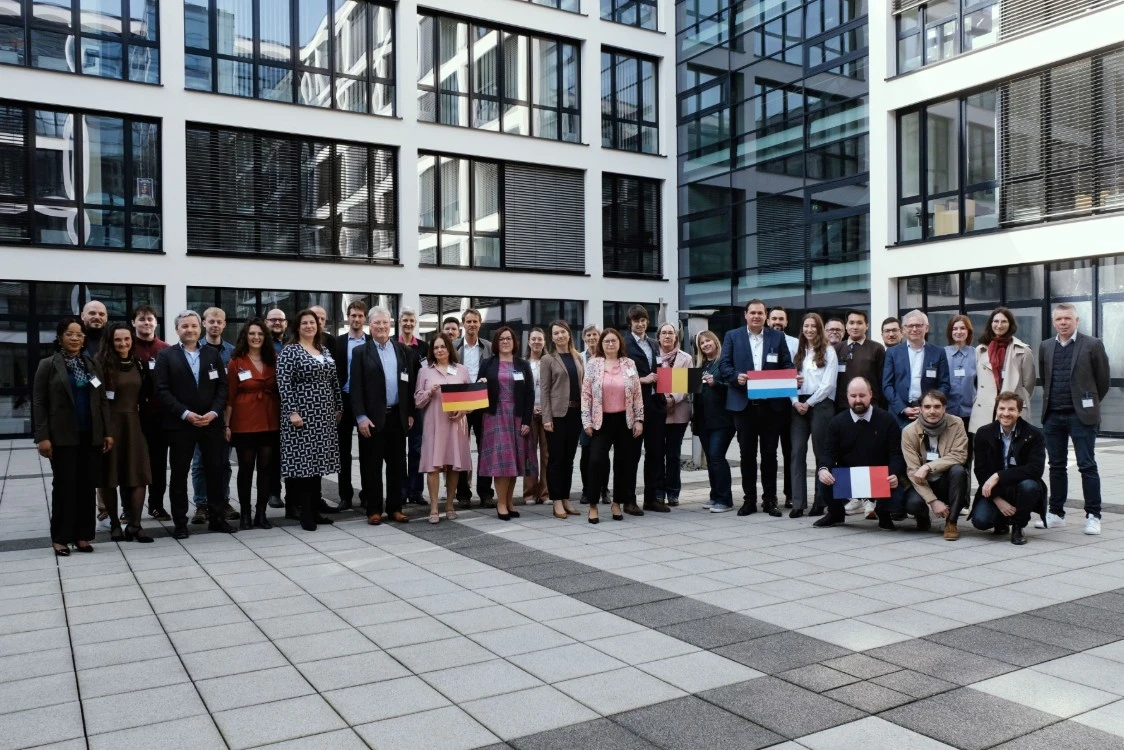
Organised jointly by the Chamber of Skilled Crafts and Luxinnovation in March, this event brought together around 70 participants and focused on artificial intelligence in SMEs as part of the Enterprise Europe Network (EEN).
The most common current applications of AI include:
- Language processing
- Recommender systems
- Machine translation
- Voice assistants
- Image recognition
- Predictive maintenance
- Route calculation
At the latest Club Inno, Christian Michel (TeamIA) demonstrated how his company uses AI to sort emails by theme and assess their priority, while Jérémy Jean (ControlC) showed how AI can analyse and organise site documents in the construction sector.
Adopting AI: Steps to a successful digital strategy
Integrating artificial intelligence into your processes requires a clear and effective digital strategy. Mickael Desloges, Senior Advisor – Assessments & Roadmaps at Luxinnovation, explains: “This starts with an audit of existing processes to identify inefficiencies and establish priorities.”
This is the purpose of the Fit 4 Digital and Fit 4 AI performance programmes, managed by Luxinnovation, where an approved consultant carries out this initial assessment and develops a roadmap.
A key aspect is knowing how to use the often large volumes of available data. “Well-structured and secure data enables better decision-making, improved customer relations and automation of tasks,” says Mr Desloges.
He also highlights the importance of a robust, scalable technological infrastructure, which may include ERP (Enterprise Resource Planning), CRM (Customer Relationship Management), MES (Manufacturing Execution System), SCADA (Supervisory Control and Data Acquisition) or cloud solutions for efficient digitalisation.
All of this must be underpinned by a highly secure infrastructure. “Cybersecurity is not optional,” warns Mr Desloges. “It is essential to protect assets, ensure data integrity and build trust in digital ecosystems.”
Financial support, in the form of direct aid from the Ministry of the Economy or tax incentives, may also be available to companies, subject to eligibility.
Luxembourg AI Factory: the one-stop-shop to implementing AI
Launched as part of Luxembourg’s national artificial intelligence strategy, the Luxembourg AI Factory is an integrated ecosystem designed to accelerate AI adoption in companies of all sizes and sectors. Its mission is to support startups, SMEs and large companies at every stage of their AI journey, from initial awareness to production deployment.
Coordinated by by LuxProvide and supported by Luxinnovation, the Luxembourg National Data Service (LNDS), the University of Luxembourg and the Luxembourg Institute of Science and Technology (LIST), the Luxembourg AI Factory offers sovereign infrastructure based on the MeluXina supercomputer. It provides end-to-end expert support: AI maturity assessment, roadmap design, data preparation, proof-of-concept development, compliance with the European AI Act and access to national and European funding.
“The Luxembourg AI Factory provides a real competitive advantage for companies, giving them access to a network of accredited AI experts, regulatory testing environments (sandboxing) in line with European law, and support in identifying funding opportunities,” says Mr Desloges.
To find out more about the Luxembourg AI Factory, the Fit 4 Digital and Fit 4 AI programmes, or the financial support available for your company’s digital transformation, the Luxinnovation team is available to assess your situation.