Gulliver: AI for smarter and greener logistics
The company aims to streamline delivery operations while promoting sustainability and operational transparency across the supply chain.
 Laurence Kayl (Fedil)
04/12/2025
[This article is part of a content series developed in collaboration with FEDIL, showcasing how artificial intelligence is contributing to the digital transformation of Luxembourg’s economy.]
Gulliver Luxembourg is an operational unit of the Brescia-based Italian technology company Gulliver S.r.l. that has been active since 2000 in the transport, HR, and sales sectors, specialising in the development of complete systems where the app is central. In addition to ready-to-use products, Gulliver creates custom projects to meet the specific needs of clients, also expanding into the world of IoT and AI.
With its flagship platform, G-Transport, already serving over 100 companies and more than 300,000 drivers globally, Gulliver has positioned itself as a leader in digital logistics innovation. The company’s mission is to streamline delivery operations while promoting sustainability and operational transparency across the supply chain.
The Challenge: Inefficiencies in modern logistics
Despite the widespread adoption of digital tools in logistics, the sector continues to face persistent inefficiencies. Fuel consumption, suboptimal route planning, and failed deliveries remain major pain points, contributing to increased operational costs and environmental impact.
Traditional routing systems often rely on static data and mileage-based calculations, failing to account for real-time variables such as traffic, weather, and vehicle load dynamics. These limitations hinder the ability of logistics providers to optimise performance and reduce their carbon footprint.
The Solution: AI-enhanced G-Transport platform
To overcome these challenges, Gulliver has developed an advanced version of its G-Transport platform, integrating artificial intelligence to revolutionise route planning and delivery management. The upgraded system introduces several key innovations:
- Predictive Failure Modeling: The platform analyses historical and real-time data to identify deliveries at risk of failure - such as those affected by customer absence, road closures, or regulatory checks - and proactively reschedules them. This reduces wasted trips and fuel consumption.
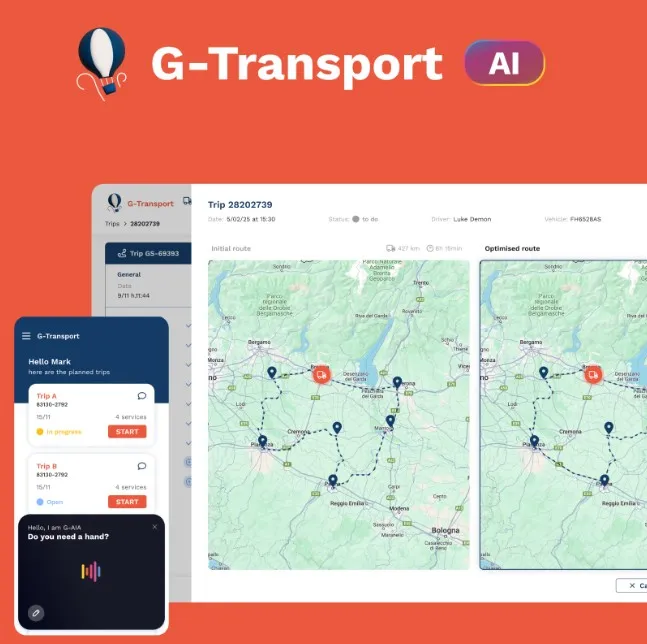
- Hybrid Route Optimization: By combining heuristic algorithms (for speed and scalability) with exact methods (for precision), the system calculates optimal routes that minimise distance and emissions. Unlike traditional tools, it factors in fuel usage, vehicle specifications, time per segment, and dynamic load weights.
- Advanced CO₂ Tracking: The platform goes beyond basic mileage-based estimates by incorporating real-world fuel data and vehicle profiles, enabling accurate carbon footprint calculations. This empowers logistics managers to implement credible green strategies.
- Mobile Interface and Real-Time ETA: A newly developed mobile app connects drivers with end customers, allowing schedule updates and real-time notifications. This improves transparency, coordination, and customer satisfaction.
- Integrated Dashboards: Users benefit from interactive dashboards that visualise performance metrics, fuel efficiency, and delivery success rates, supporting data-driven decision-making.
 Performance insights and strategic roadmap
Initial tests of the AI-enhanced G-Transport platform have demonstrated a 16% reduction in CO₂ emissions compared to standard routing solutions like Google Routing APIs. This improvement is directly attributed to the hybrid optimisation model and predictive rescheduling capabilities.
Additionally, the platform has shown increased on-time delivery rates and reduced operational overhead, contributing to both economic and environmental benefits.
The project also aligns with Luxembourg’s national priorities in digital transformation and green mobility. Gulliver’s collaboration with the University of Luxembourg’s Interdisciplinary Centre for Security, Reliability, and Trust (SnT) ensures access to cutting-edge AI research and supports the local talent pipeline. Gulliver anticipates significant economic contributions through job creation in AI engineering, software development, and logistics management. The company’s expansion in Luxembourg is expected to attract further investment and foster an innovation cluster in the region. As logistics underpins multiple industries, improvements in transport efficiency can ripple across retail, manufacturing, and distribution sectors.
The AI features are currently being piloted with select transport and logistics firms, with plans for rapid large-scale deployment. Given that G-Transport already supports over 300,000 drivers globally, the rollout of these enhancements is expected to be swift and impactful. Future developments include support for multimodal transport (road, rail, sea) and continuous adaptation to evolving environmental regulations.
By embedding AI into its logistics platform, Gulliver is delivering measurable ecological and economic benefits while setting new standards for intelligent and sustainable transport management.


.jpg)