Master of Lore: AI gives tabletop roleplaying a voice
In the magical world of role-playing games, Luxembourg-based firm builds artificial intelligence (AI) that serves the game master instead of replacing them.
 Jean-Michel Gaudron
10/11/2026
[This article is part of a content series developed in collaboration with FEDIL, showcasing how artificial intelligence is contributing to the digital transformation of Luxembourg’s economy.]
 Tabletop roleplaying games depend on one person: the game master, who narrates the story and plays every character the players meet. Master of Lore, developed in Luxembourg, keeps that person at the centre.
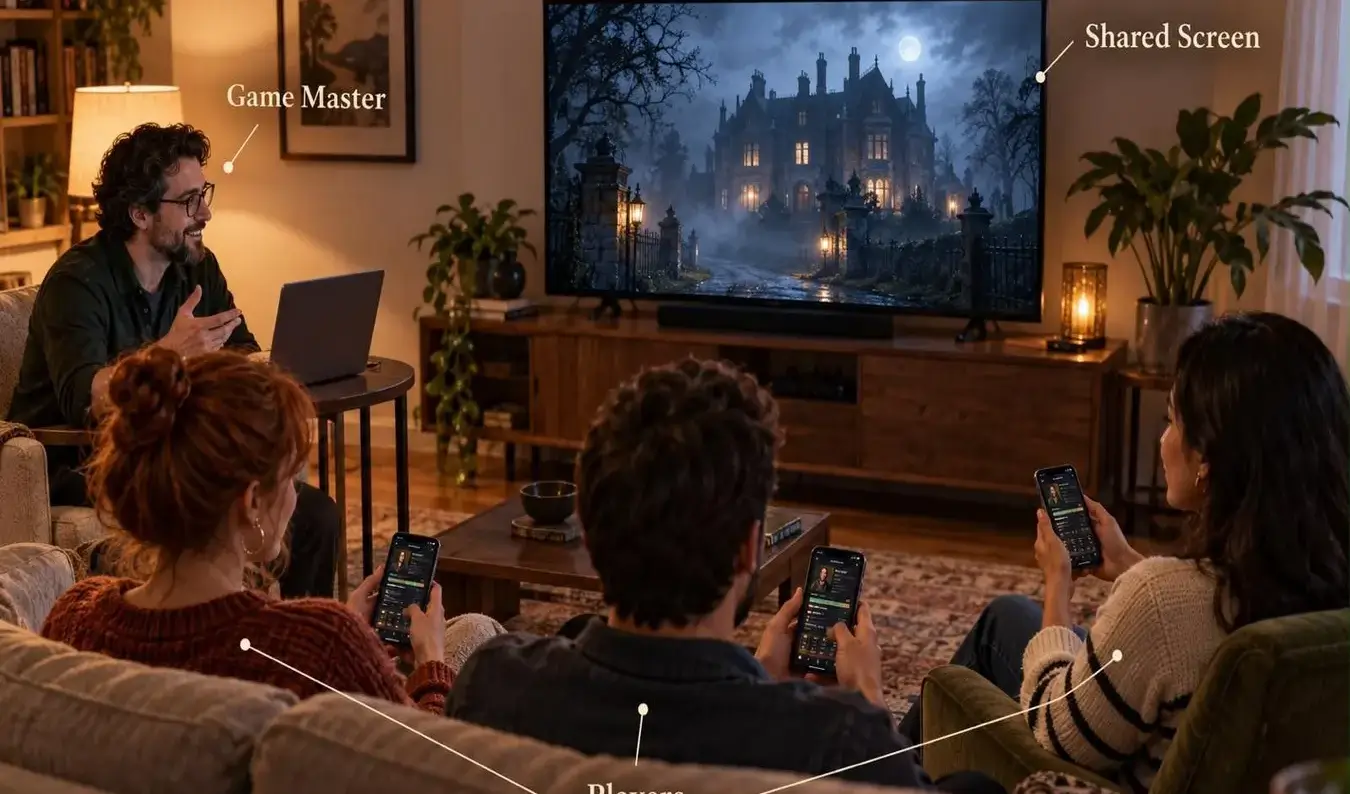
The game master runs the session from a console. Players join from their phones by scanning a code. A shared screen carries imagery, voiced narration and a musical score, for players at the table and remote players alike. A full authoring back-office lets game masters build their own worlds.
A growing market with a gap in atmosphere
According to specialised media ICv2, the hobby games market in the United States and Canada reached $3.66 billion in 2025, up 40% year on year. Wizards of the Coast studios, on the other hands, counts over 85 million Dungeons & Dragons players worldwide.
Most attempts replace the game master with a chatbot, which removes what players come for. That’s why we took the opposite approach. Ashley Eden, Master of Lore
The audience has already moved online. Roll20 online tool platform has around 10 million accounts and D&D Beyond over 20 million, according to the company. Ashley Eden, Communication manager of Master of Lore, sees a limit in these tools: "A virtual tabletop renders a grid; it does not give the table a voice, an image and a score at the moment the door opens."
AI that serves the game master
"Most attempts replace the game master with a chatbot, which removes what players come for," explains Mr Eden. “That’s why Master of Lore the opposite approach.”
This approach is built on three principles:
- Bounded knowledge: each non-player character carries only the common knowledge of its scene, not the full scenario. A coroner therefore does not reveal the murderer simply because the text contains the answer. Mr Eden describes this as the hardest problem in the medium and says the team solved it structurally.
- Human arbitration: effects that always apply are handled mechanically. Effects that depend on circumstance are narrative and judged by the game master at the table. The system executes and never pretends to understand the fiction.
- Production beyond one person's reach: AI generates voiced narration and dialogue, imagery, ambience, scored sequences and tactical battlefields. A game master could not prepare this alone on a weeknight. The company states that it delivers it at a measured cost per session.
One paying customer for a whole table
The commercial model rests on the game master. One paying customer serves an entire table, and that person decides whether the group keeps playing.
Two complete games already run on the same engine: a fantasy setting and a 1920s Lovecraftian setting. Each has a full rulebook and 200 catalogued items. Adding a world does not require rebuilding the engine.
Status and next steps
Master of Lore is in its final stage of development. Complete sessions run end to end, in person and remotely. Demonstrations are scheduled to start in November 2026, and a crowdfunding campaign is planned for February 2027.