Quantum ecosystems - overview of major worldwide ecosystems
As quantum technologies move from the lab to real‑world applications, global ecosystems are forming to secure early advantage. This report provides an in‑depth look at the world’s most advanced quantum hubs and the strategic forces driving their growth.
Global quantum race
Quantum technologies are at the forefront of the next technological revolution, promising transformative impacts across computing, communication, sensing and cybersecurity. As nations and regions race to develop quantum capabilities, ecosystems are emerging worldwide, driven by strategic investments, cutting-edge research and the creation of highly skilled talent pools. These ecosystems are not only shaping the future of science and industry but also redefining global competitiveness in the digital era.
Global overview
... in global public investments
... in investors' deals
The Americas have experienced a major surge in 2021–2022, partly thanks to a handful of major deals, before dropping in the following years. Asia, which led in 2020, shows a consistent decline throughout the period, reaching its lowest point in 2023 with only a small rebound in 2024. In contrast, Europe demonstrates the most stable and generally upward trend.
There is not a single cause to these regional shifts. Quantum startups saw a big spike in 2021–2022 (large late-stage rounds) and then a sharp drop in venture activity in 2023 as global VC tightened and investors de-risked. Several sector reports call this a correction (sometimes labelled a short “quantum winter”). In China, investments mainly come from public support, and private VC investments are more unstable.
2025 marks a turning point: after the fluctuations of previous years, the market regained momentum with major strategic deals across all hubs, signalling renewed confidence in quantum technologies.
Figure: Deal size by funded companies location (2020 - 2025)
(in $M)
Source: Pitchbook
Deep dive into the 3 major hubs
North America: Global innovation hub
North America, in particular the United States and Canada, is classified as a global innovation hub. This ecosystem is highly connected internationally and commercially mature, characterised by strong industry involvement and dense partnerships. The US is the most central player in the global quantum collaboration network, acting as both a hub and a broker, linking otherwise disconnected countries. Public investment is substantial ($7.67B in the US), but what truly differentiates North America is its industry-driven approach: tech giants (IBM, Google, Microsoft, Amazon) dominate quantum computing, complemented by a vibrant startup scene and aggressive venture capital funding. Their key strength is the rapid translation of research into market-ready solutions through strong academia-industry synergy.
Asia: Government-centric and research-heavy
Asia, dominated by China and Japan, fits the research networker archetype. The region is deeply embedded in global scientific networks but less commercially mature than North America. China leads in quantum communication research (39% of global publications) and allocates the largest public funding globally ($15.3B), reflecting its state-centric model. Regulations in China is much less present than in other countries. Japan complements this with initiatives like Q-LEAP (2018) and the Vision of Quantum Future Society (2022), focusing on quantum computing and sensing. Private-sector dynamism is limited: startups are few (11 in China, 9 in Japan), and investment flows are volatile, dominated by government programmes rather than VC.
Europe: Collaborative and balanced
Europe positions itself as a global innovation hub, though with a more collaborative and risk-mitigated approach compared to North America. The EU leads in collaboration volume globally, underpinned by initiatives like the Quantum Flagship and Horizon Europe. Countries such as the UK, Germany and France combine strong academic research with structured industrial participation. Europe hosts 542 companies and 293 startups, supported by stable public funding ($5.49B UK, $3.45B Germany, $2.07B France). Europe can enjoy cross-border collaboration and ecosystem stability, fostering gradual but sustainable commercialisation.
Real-world examples
D‑Wave & Japan Tobacco’s quantum‑AI workflow for generative drug discovery
In March 2025, D‑Wave and Japan Tobacco’s pharmaceutical division (JT) completed a proof‑of‑concept project showing how quantum computing can improve AI‑driven generative drug discovery. Their goal was to design a workflow where D‑Wave’s annealing quantum processors enhance the training of large language models (LLMs) used to generate new small‑molecule drug candidates.
According to The Quantum Insider, the teams built a quantum‑hybrid workflow, combining classical computation with D‑Wave’s quantum processing unit (QPU), to train generative AI models that explore chemical space and propose novel molecules. This hybrid approach generated more valid and more “drug‑like” molecules than traditional classical‑only methods. Molecules created through QPU‑assisted training also showed higher drug‑likeness scores and better energy efficiency, suggesting quantum sampling helped the AI model learn better chemical structures.
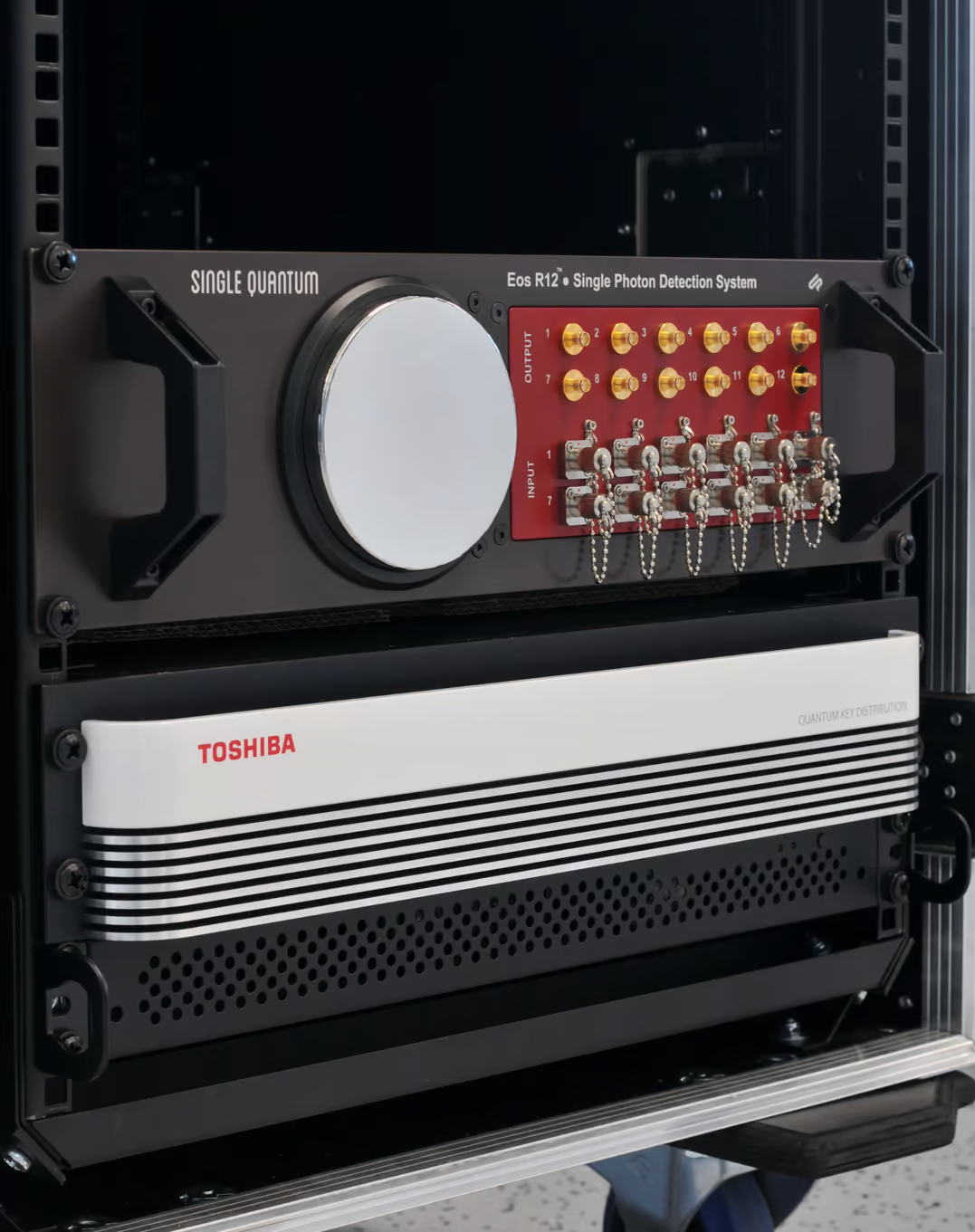
Toshiba & Single Quantum extend long‑distance QKD using SNSPDs
Toshiba Europe and Single Quantum have collaborated to extend the transmission range of Quantum Key Distribution (QKD) to 300 km and beyond over a single fibre link. The key breakthrough comes from validating Toshiba’s QKD system together with Single Quantum’s superconducting nanowire single‑photon detectors (SNSPDs), which offer extremely low noise and high detection efficiency. These detectors allow accurate single‑photon detection even over high‑loss fibre links, enabling secure QKD without the need for intermediate trusted nodes.
Traditionally, QKD links max out around 150 km because optical losses weaken quantum signals. Network operators typically compensate by deploying trusted nodes (secure intermediate stations that relay keys). However, this is not always feasible for marine cables, cross‑border fibre or remote areas where suitable infrastructure does not exist. By using Single Quantum’s SNSPDs, the joint solution significantly increases the viable link distance, reducing or eliminating the need for such nodes.
Altice Labs demonstrates quantum‑secure network for military applications
Altice Labs has successfully demonstrated a quantum‑secure tactical communications network for military use as part of the European defence project DISCRETION (Disruptive SDN Secure Communications for European Defence). The demonstration took place on 29 January 2025, at the Portuguese Embassy in Brussels and showcased how quantum technologies can be integrated into software‑defined military radio networks.
The DISCRETION project is a €6 million initiative funded by the European Commission, the Portuguese government and private partners. It brings together an international consortium led by Portugal’s Deimos Engenharia, with contributions from Altice Labs, Adyta, Instituto de Telecomunicações, Instituto Superior Técnico, Telefónica ID, the Polytechnic University of Madrid, the Austrian Institute of Technology and NEXTWORKS.