
EIC 2026: Transforming breakthroughs into market success
Discover how to access over €1.4 billion in EIC funding through Pathfinder and Accelerator schemes.
 Jean-Michel Gaudron
23/02/2026
The European Innovation Council opens over EUR 1.424 billion in 2026 across five main schemes (Pathfinder, Transition, Advanced Innovation Challenges pilot, Accelerator, STEP Scale‑Up), offering Luxembourg-based innovators extensive access to funding for deep tech and breakthrough technologies from early science to scale‑up.
From bold science to market entry: How the EIC fits together
The EIC Pathfinder backs exploratory research at a Technology Readiness Level (TRL) from 1 to 4, focusing on high‑risk, high‑gain ideas that could underpin radically new, tangible technologies.
In 2026, Pathfinder grants go up to €4 million per project, and winners can draw on the EIC’s Business Acceleration Services (BAS) for tailored mentoring and ecosystem access.
As your concept proves out and your technology matures, you can step up to the EIC Accelerator, which supports late‑stage development and market entry (TRL 6-9), combining a lump‑sum grant (up to €2.5 million) with equity (€1–10 million) via the EIC Fund (with investment advice from the European Investment Bank).
Accelerator winners also access BAS to refine strategy and connect with partners and investors.
Pathfinder and Accelerator offer an all‑topic Open call that welcomes any breakthrough idea or technology, alongside themed Challenge calls that target predefined EU priority areas.
2026 Save-the-dates: Important deadlines
For 2026, the EIC Pathfinder Open call has a deadline of 12 May 2026, while the Pathfinder Challenges close on 28 October 2026.
Meanwhile, the EIC Accelerator accepts short proposals on a rolling basis, batched on the first Tuesday of each month for evaluation. For full proposals, you can choose one of the following dates for submission: 4 March, 6 May, 8 July, 2 September, and 4 November 2026.
Have a look at the EIC 2026 Work Programme in case of doubt as well as the EIC website!
Key Changes: What’s different from 2025
In 2026, EIC Pathfinder Open raises its grant ceiling to €4 million per project (up from €3 million in 2025), expands the technical description limit to 22 pages (formerly 20), and switches to a lump‑sum funding model. Applicants must now include a detailed budget table at proposal stage, which is then used during grant preparation to justify and set the lump‑sum amount.
In 2026, the EIC Accelerator introduces to‑the‑point, evidence‑oriented templates: the full‑proposal technical description is now 20 pages (down from 50 in 2025).
Batching is more frequent, with six full‑proposal cut‑offs across the year, three interview rounds, and monthly batching of short proposals to speed up feedback and decisions.
In addition, due diligence moves up front: a dedicated Technology Expert conducts in‑depth technical checks (including a remote interview) during the full‑proposal stage, and their findings feed the external evaluation panel.
Finally, the Open budget increases from €384 million (2025) to €414 million (2026), creating more room for high‑potential, non‑thematic proposals.
For more information, have a look at the official EIC 2026 Info Day recording!
Programme manager priorities and lessons to apply
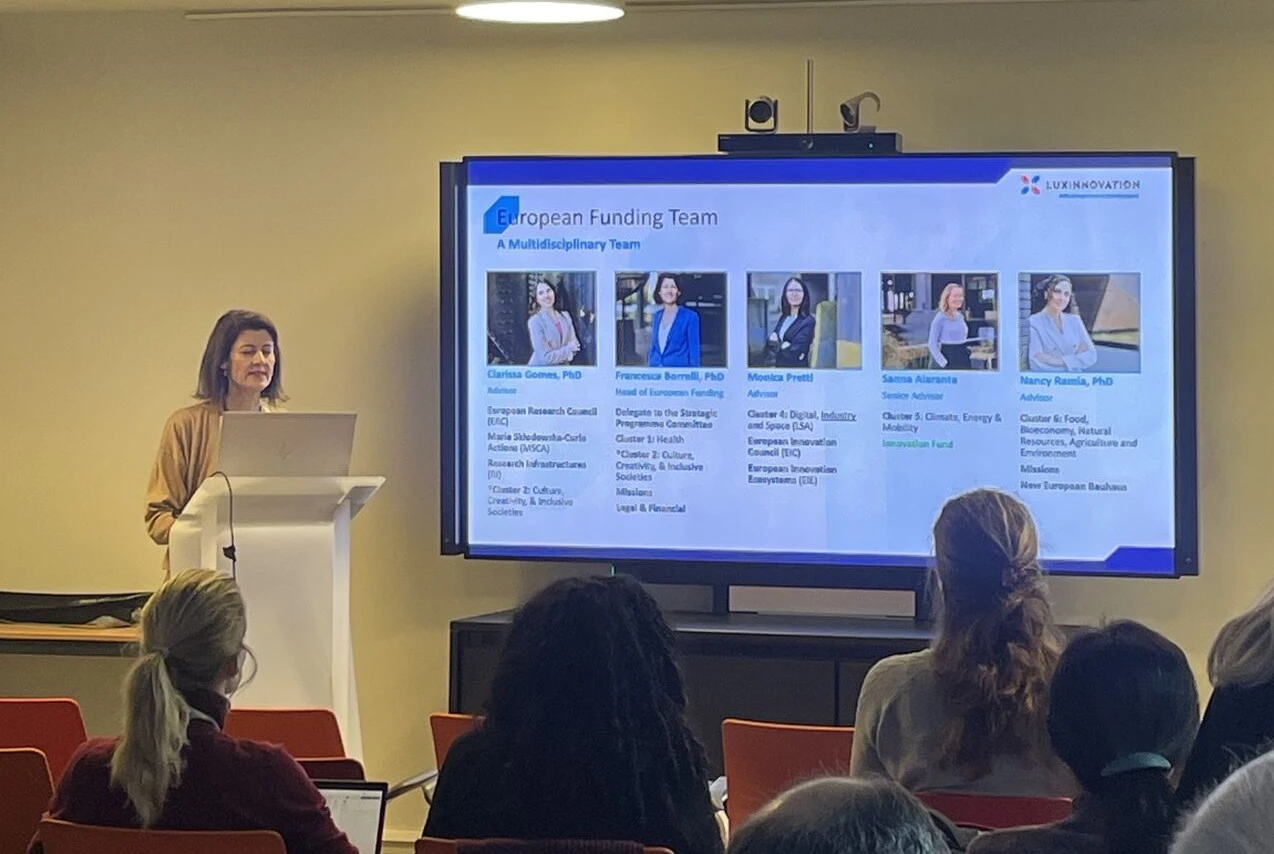
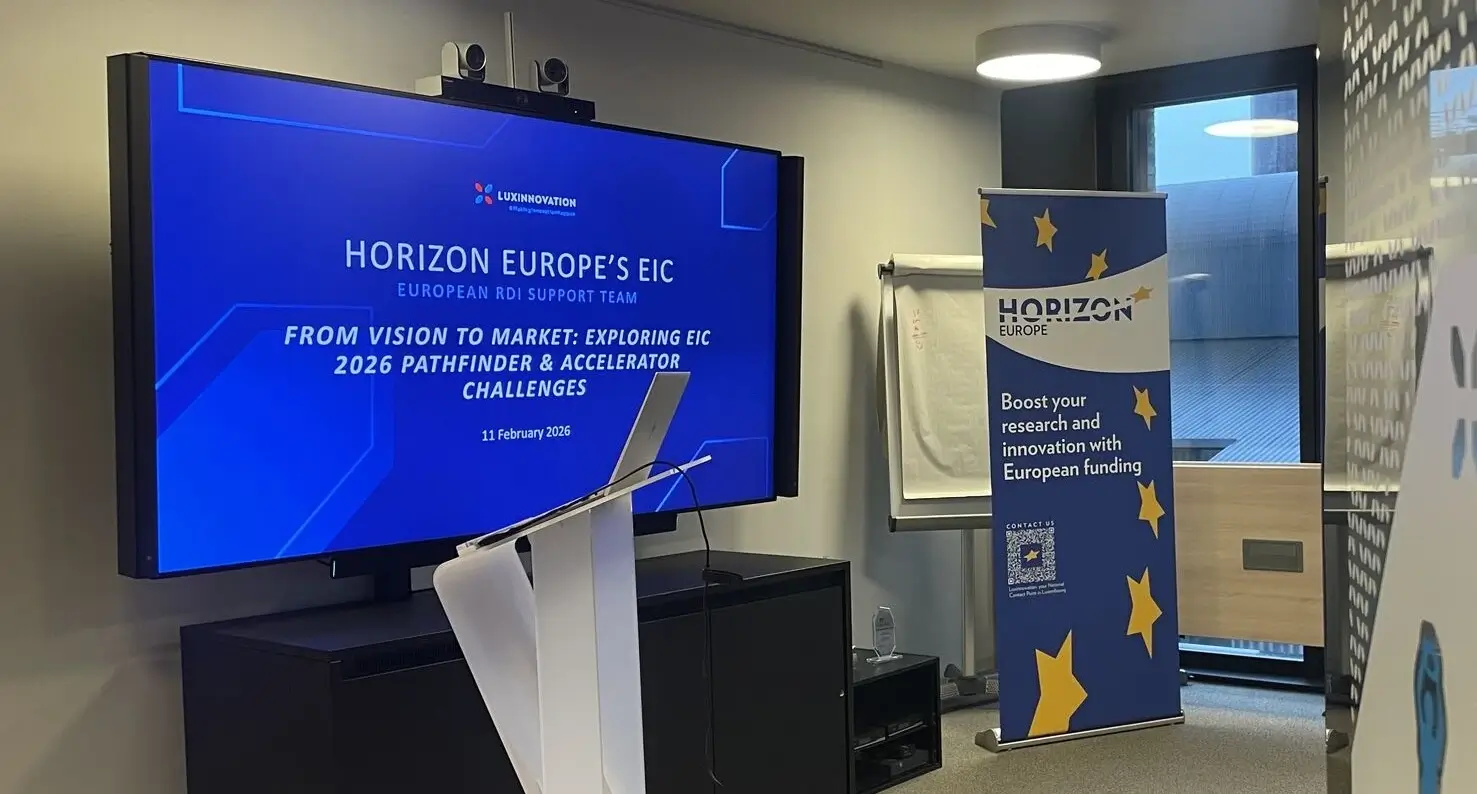
In the EIC Pathfinder, Programme managers look for proposals driven by bold scientific unknowns, as Hedi Karray, Paolo Bondavalli and Ivan Stefanic sharedat at the "Horizon Europe’s EIC: From Vision to Market" event, organised by Luxinnovation in February. Projects have to clearly explain why existing approaches cannot deliver the envisioned breakthrough and how hypothesis pushes the frontier forward.
They expect explicit state‑of‑the‑art positioning with quantified advantages over the most relevant alternatives (not generic claims) and, for Challenge calls, evidence of complementarity with the curated portfolio, including an allocation of 10 person‑months for portfolio activities.
The testimonies of Dr. Emmanuel Defay (LIST) and Dr. Xavier Kohll (R3Robotics, former Circu Li-ion) yielded four major lessons:
- Target a tangible, testable breakthrough rather than incremental progress, with a proof-of-principle by project end;
- Benchmark with numbers, setting expected gains against today’s best‑in‑class;
- Show ‘science now, innovation tomorrow’ by mapping a credible line of sight to next steps (e.g., EIC Transition), including IP strategy, early standardisation/regulatory foresight and potential applications;
- Ensure mid‑ to long‑term market alignment. You do not need short‑term revenue, but you should know how to ease downstream uptake.
In the EIC Accelerator, strong applications typically centre on breakthrough technology at TRL ≥ 6.
Public investment is generally warranted where the market exhibits technical, regulatory, or timing risks that private capital will not shoulder alone, with EIC funding acting to de‑risk the case and attract co‑investors.
Competitive proposals are supported by a team able to navigate the “Valley of death”, reflected in clear governance, planned hires, and partnerships.
Go‑to‑market plans under real‑world constraints usually specify deployments on a timeline, a defined regulatory/standards pathway, secured suppliers or contract manufacturers and a phased capacity ramp to revenue.
Capital efficiency is often visible in a blended plan that assigns the grant to TRL 6-8 innovation activities and equity to industrialisation and commercial scale‑up (TRL 9), both tied to milestones.
Finally, European impact beyond the startup is articulated through contributions to standards and skills, anchoring of manufacturing and IP in Europe, and reduced extra‑EU dependencies aligned with EU strategic autonomy.
Common pitfalls include:
- KPIs presented without baselines and over‑broad objectives that dilute attention from core hypotheses and outcomes.
- Unclear applications arise when concrete use cases, users, and settings are not specified, while Pathfinder consortia formed by convenience – rather than fit‑for‑purpose teams mapped to critical work packages – tend to weaken execution credibility. Clarity also suffers with jargon‑heavy writing. Plain language and visuals typically communicate evidence more effectively.
- Evaluation that is often undermined by under‑evidenced or unclear TRLs, where the entry TRL is expected to be stated and supported by data. Finally, financials that do not match the ask, budgets and milestones not precisely aligned with the funding request, raise red flags.
Some final wisdom:
- Rejection often functions as a catalyst for improvement. Each ‘no’ becomes a chance to absorb evaluator feedback and sharpen the case.
- Stronger outcomes typically follow tighter writing and richer evidence, i.e., compelling narratives anchored in robust methodology, validation, and a clear regulatory pathway.
- Ambition also travels best with plausibility: projects that articulate a bold vision while demonstrating feasibility and relevance, substantiating novelty, expected impact, and a credible route to uptake, tend to resonate most with evaluators.
Next steps for Luxembourg innovators: Call to action
As Luxembourg’s National Contact Point for Horizon Europe, Luxinnovation provides tailored advisory support to help Luxembourg-based researchers and SMEs navigate EIC eligibility, review proposals, connect with consortium partners (if applicable), and rehearse with mock interviews.
With key 2026 dates approaching, early engagement with the NCP means locking the right funding path and cut‑off, double-checking eligibility and TRL claims, lining up partners or mock interviews, and submitting a sharper, fully evidenced proposal on time.