Measuring to act: initiating your carbon footprint
Understanding what a carbon footprint is, and knowing which levers to use to reduce it, are essential for companies wishing to combine efficiency with sustainability.
 Jean-Michel Gaudron
01/07/2026
At a time when sustainability and energy sobriety are key priorities for any company aiming to adopt increasingly virtuous behaviours, the main reference indicator remains the measurement of the carbon footprint.
The aim is to determine the total quantity of greenhouse gases (GHGs), expressed in CO₂ equivalent, emitted directly or indirectly by a human activity, an individual, a product, a company or a territory.
This approach is a direct continuation of the concept of the ecological footprint, developed in the early 1990s by Mathis Wackernagel and William Rees.
How is the carbon footprint calculated
Corporate emissions can be considered according to three different scopes:
- Scope 1: direct emissions, physically produced by companies' operations and the sources they own (combustion of fuel for the vehicle fleet, gas consumed for space heating, leaks of refrigerant gases from air conditioners or refrigerators, etc.)
- Scope 2: indirect emissions linked to the production of energy purchased and consumed by the organisation (electricity, heat, steam)
- Scope 3: other indirect emissions inherent in the value chain. This is the largest and most complex scope, encompassing all other emissions both upstream (via suppliers) and downstream (via customers), as well as those due to employees themselves. It generally represents the majority of the carbon footprint of an organisation, especially smaller ones.
Transport, the main contributor to the carbon footprint
Globally, energy-related CO₂ emissions amounted to some 37.8 gigatonnes, or 37,800 million tonnes, in 2024. At Luxembourg level, the latest generic data established by Eurostat date from 2023 and indicate 12.63 tonnes emitted per capita. This is one of the highest levels in the European Union, but this figure should be put into perspective.
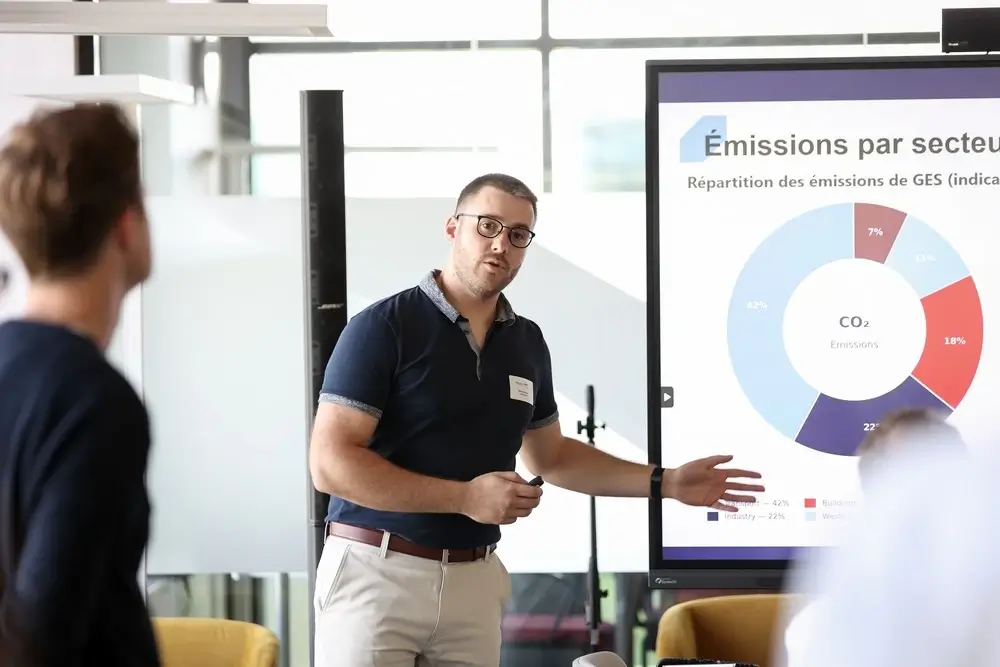
"A large part of this comes from emissions from the transport sector. However, the many vehicles that only pass through the country to refuel are also included, which has a strong impact on this high figure," explained Clément Streicher, Business Relationship Advisor – Skilled Crafts at Luxinnovation, during a workshop dedicated to the carbon footprint as part of the recent Klimapakt fir Betriber day.
In Luxembourg, more than 55% of GHGs come from the transport sector. "The government has put in place a number of measures to reduce this proportion." The target set out in the integrated national energy and climate plan (NECP) is between 25 and 37% renewable energy use by 2030.
Carbon footprint, the key steps
The process for calculating and assessing the carbon footprint can be structured in five key steps:
- Choosing the scope – "This is the starting point for defining the depth of analysis," says Streicher. It is a matter of choosing the desired dimension (operational or financial) and the scopes to be included in the calculation;
- Collecting activity data – Energy bills, fuel purchases, transport statements, supplier invoices, waste volumes, business trips, etc. everything must be taken into account;
- Applying emission factors – Activity data must be converted into CO₂ using standardised emission factors (ADEME, DEFRA, ecoinvent databases, etc.);
- Calculation and categorisation – Emissions by scope and source must be added together in order to build a complete GHG inventory. "This involves the use of online carbon accounting tools adapted to SMEs," says Streicher;
- Goal setting and iteration – The idea is to set realistic science-based goals and prioritise the most important actions before implementing reduction measures. "It is important to carry out an initial assessment to see what is improving, and then to start again every year. It is essential to be able to monitor progress annually."
Klimapakt fir Betriber: support for companies in decarbonisation and energy transition
The Luxembourg government (Ministry of the Economy and Ministry of the Environment, Climate and Biodiversity), with the participation of Klima-Agence and Luxinnovation, has set up the Klimapakt fir Betriber initiative.
It offers companies a structured and coordinated approach that facilitates access to the various initiatives, programmes, support services and financial aid available to help them in their decarbonisation and energy transition efforts.
A catalogue of measures is available online. From the simplest to the most innovative, they are ready to be applied by any type of company, small or large. These measures can vary in scope, from the installation of a photovoltaic system to applying for subsidies or developing a renovation concept.
In addition to the ministries concerned, Klima-Agence and Luxinnovation, a steering committee supports the implementation of the Klimapakt fir Betriber programme. It is composed of representatives of the Federation des Artisans, the FEDIL, the Chamber of Skilled Crafts, the Chamber of Commerce and the Luxembourg Confederation.
Fit 4 sustainability: assessing and reducing environmental impact
The Fit 4 Sustainability programme, managed by Luxinnovation, helps companies assess and reduce their environmental impact. This enables them to reduce costs, improve their reputation and win new customers who value a sustainability-focused approach.
Fit 4 Sustainability offers the opportunity to work with an experienced specialist, who helps the company analyse its environmental impact and develop a roadmap to improve its sustainability.
Thanks to this scheme, companies can carry out a carbon assessment and benefit from financial support in this process.
Would you like to know more about reducing your carbon footprint and the Fit 4 Sustainability programme? Contact Luxinnovation.

.jpg)