

Can the ancient brain still innovate in the age of AI?
Sébastien Bohler revealed during a keynote at Scynergy how the brain's dopamine system drives unsustainable innovation and shared a five-step strategy for conscious, mindful progress.
 Emilio Naud
24/04/2026
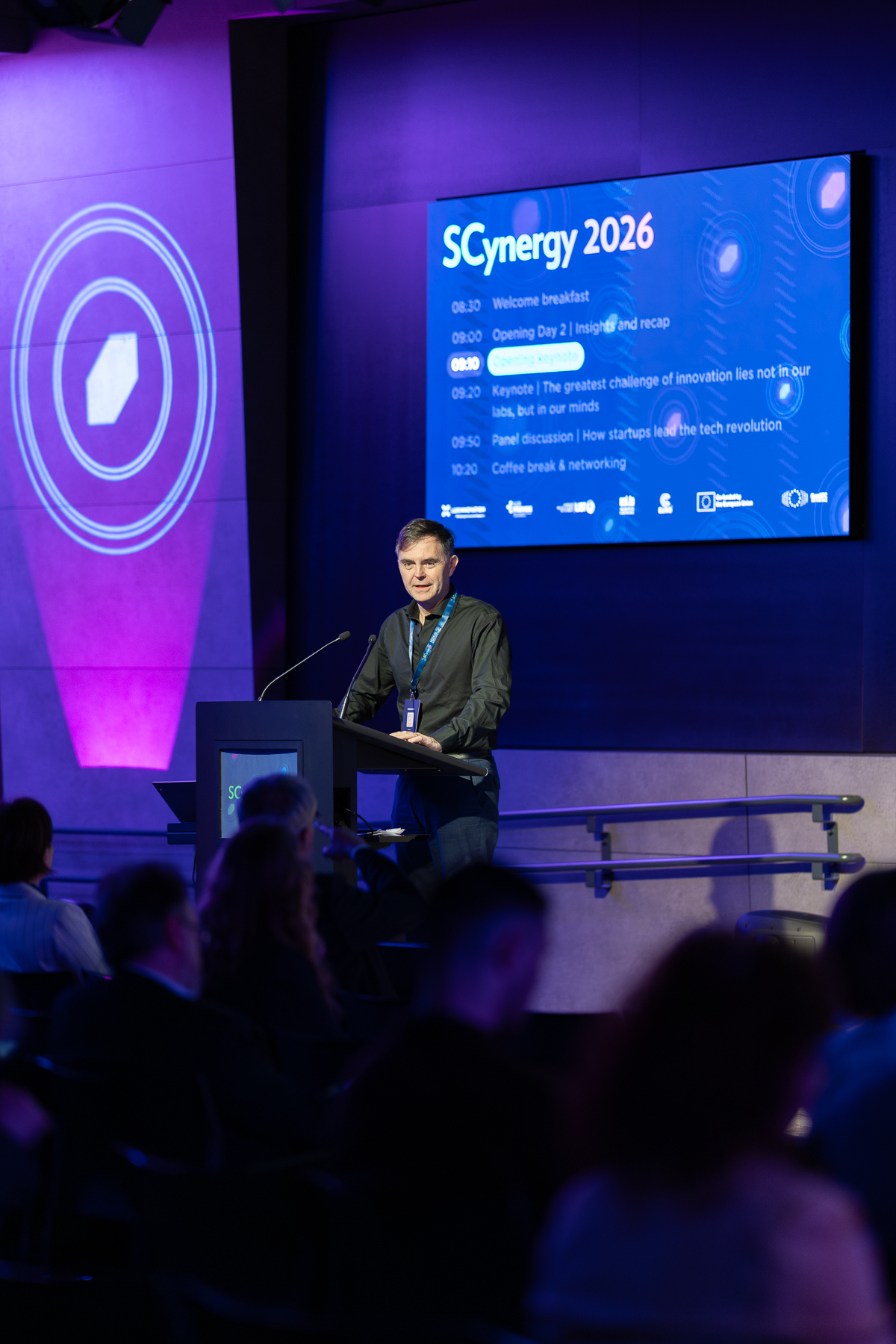
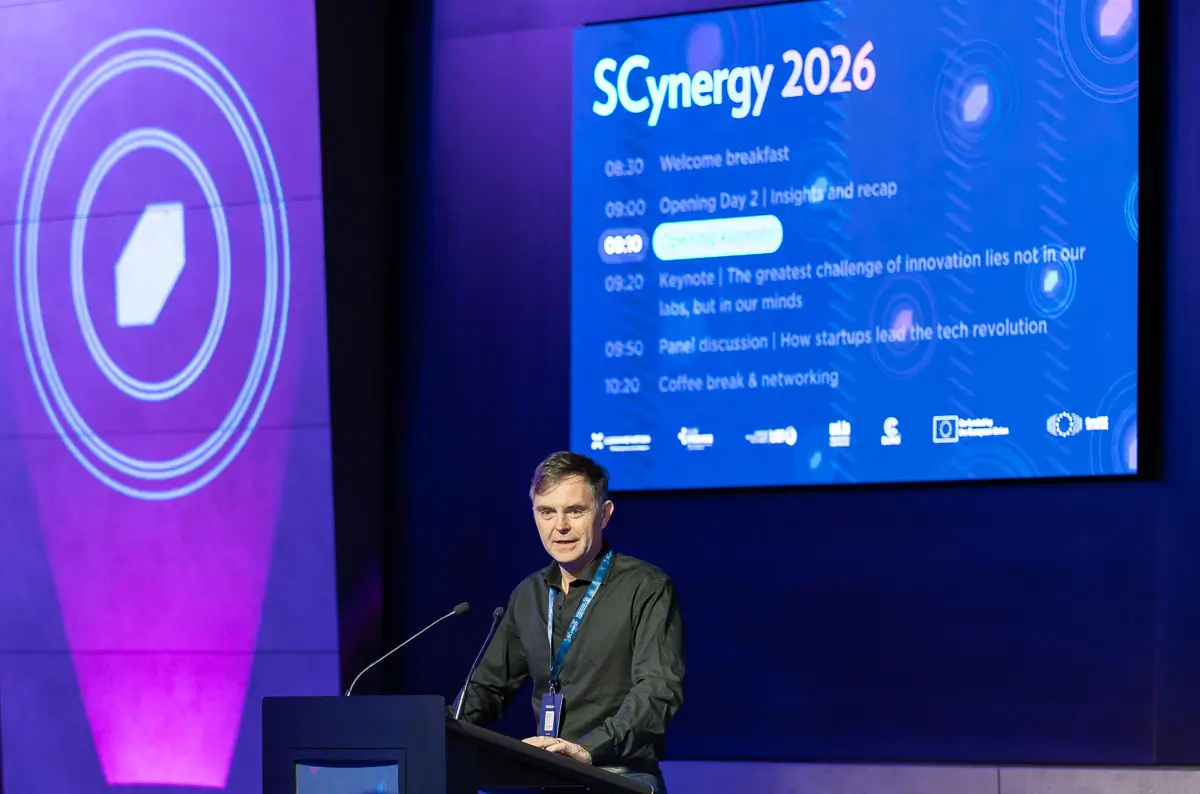
Sébastien Bohler, Editor-in-chief of “Cerveau et Psycho” gave a keynote about the mental challenges of innovation during Scynergy, an event that took place on 15 April 2026 at the Chamber of Commerce in Luxembourg.
How the brain's ancient wiring drives unsustainable innovation
Bohler began by tracing innovation from the first stone tools three million years ago to today's artificial intelligence, noting a clear parallel between the growth of human innovation and the physical growth of our brain’s volume. While this has gifted our species an unparalleled talent for creation, it has come at a cost. "Our intelligence is killing us," Bohler stated starkly, pointing to the catastrophic rise in greenhouse gas emissions as a direct result of our industrial and technical progress.
To explain this paradox, Bohler delved into the brain’s architecture, contrasting the modern, intelligent outer cortex—the source of our innovation—with the ancient, inner striatum. Unchanged for 350 million years, the striatum is our survival engine. It operates on a simple system of dopamine rewards, driving five core behaviours:
- Consuming food
- Seeking mates
- Gaining social status
- Acquiring information
- Minimising effort
This system, Bohler emphasised, has no "stop function." It is programmed to always want more, a perfect survival kit for our ancestors in a world of scarcity, but a dangerous liability in a world of abundance.
The conflict arises when our innovative cortex creates technologies that offer an unlimited supply to these limitless, primitive desires. Our striatum, unable to self-regulate, is overwhelmed. Industrial agriculture provides infinite food, leading to obesity and environmental damage. The internet offers a constant chase for validation through social media 'likes', contributing to a digital sector that Bohler noted now emits more greenhouse gases than air traffic. "Many innovations," he observed, "just satisfy the need to minimise our efforts," citing AI as the latest tool catering to this primal drive. This has resulted in a world of "infobesity," where we are overloaded with useless information we are programmed to crave.
How do we resolve this mismatch?
Bohler proposed a "five M" strategy to generate dopamine without planetary harm:
- Mastering — controlling impulses through conscious practice
- Meaning — aligning actions with personal and societal values
- Mindfulness — deriving greater satisfaction from less consumption
- Memory — using learning as a source of reward
- Mutualising — finding fulfilment through sharing and altruism
Bohler argued against simply suppressing the striatum, which would eliminate all desire. "When we change the norms in society, we change our brains," he concluded, calling for an innovation of the mind itself.
What conscious innovation means for Luxembourg's tech sector
Bohler's analysis raises a critical question for the technology sector: as artificial intelligence becomes more embedded in our daily lives, how do we ensure it serves humanity's long-term wellbeing rather than just our most primitive impulses?
For businesses in Luxembourg, the answer lies in conscious innovation — designing technologies that are competitive, ethical and human-centric. Luxinnovation supports companies in this transition through programmes such as Fit 4 Sustainability and advisory services that help align business strategy with sustainable development goals.