SolarCleano: Tracking down solar panel defects with AI
Specialising in innovation and the development of robotic solutions for cleaning solar panels, the company is adding a new capability to its portfolio: automated detection and management of solar panel defects.
 Jean-Michel Gaudron
15/01/2026
[This article is part of a content series developed in collaboration with FEDIL, showcasing how artificial intelligence is contributing to the digital transformation of Luxembourg’s economy.]
Photovoltaic energy continues to grow year on year. According to the French energy group EDF, solar photovoltaic power accounted for 5.4% of global electricity production in 2023, representing a 25% increase compared with 2022.
In Luxembourg, the proportion is significantly higher. In 2024, data from the Luxembourg Regulatory Institute show that solar energy accounted for almost a quarter of national electricity production, an increase of 22.4% in just one year.
With an installed capacity of nearly 550 MW, photovoltaics now represent by far the largest share of the country’s renewable energy mix, well ahead of wind power (215 MW) and biomass (75 MW).
The rapid and continuous expansion of solar power plants, often comprising thousands of photovoltaic modules, has led to growing demand for efficient cleaning, monitoring and maintenance solution.
In collaboration with the SnT
Founded in Luxembourg in 2017, SolarCleano is a robotics company specialising in innovative solutions for solar panel cleaning. Its autonomous robots are deployed in more than 100 countries worldwide and are used to clean hundreds of gigawatts of solar installations.
“Although photovoltaic panels have an expected lifespan of up to 25 years, they degrade at an average annual rate of 0.5%, which can increase significantly due to environmental stress and material ageing,” explains Andreas Kokkas, R&D Project Leader at SolarCleano.
Given the scale of modern solar farms, manual quality control is simply not feasible. To address this challenge, the company partnered with the Interdisciplinary Centre for Security, Reliability and Trust (SnT) and the Hamelin Solar Energy Research Institute (ISFH) to develop solutions based on advances in robotics and artificial intelligence, particularly computer vision.
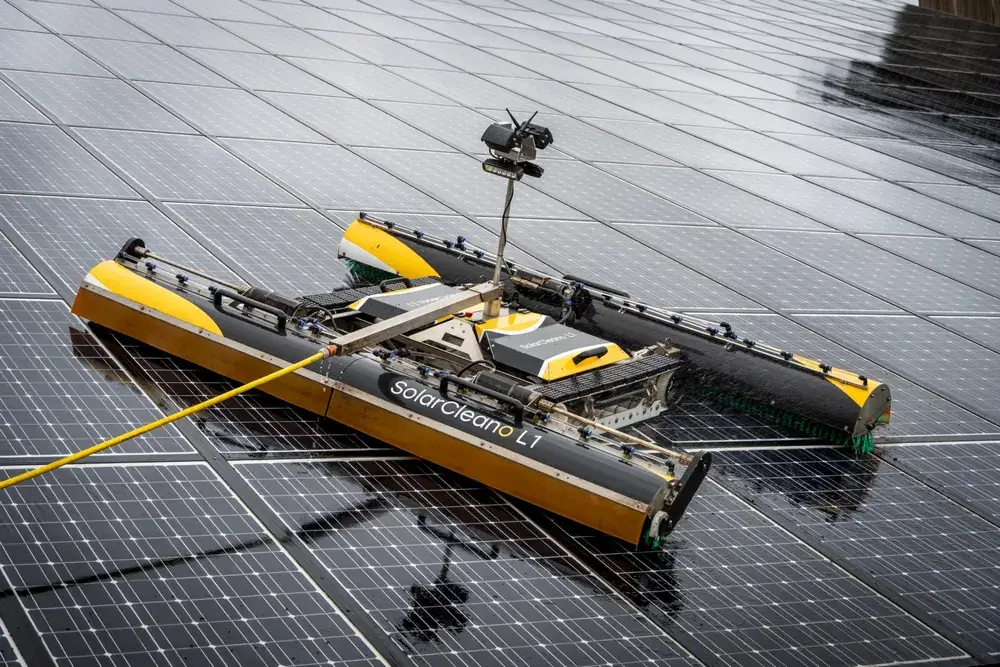
This collaboration gave rise to the ambitious PVDetects / Spider AI projects (Solar Panel Identification and Defect Recognition using Artificial Intelligence). These initiatives transform SolarCleano’s autonomous cleaning robots into intelligent, multifunctional platforms capable of inspecting photovoltaic modules using state-of-the-art thermal and RGB imaging combined with embedded artificial intelligence.
“The project integrates cutting-edge hardware and software, including data acquisition, dataset development and a complete inspection workflow based on the Robot Operating System (ROS),” says Shiva Hanifi, PhD student in robotic vision at SnT.
Cameras, sensors, on board processing...
The system incorporates RGB and thermal cameras, sensors, LED lighting and on-board processing capabilities. Combined with analysis modules developed by the SnT, it enables the robot to autonomously integrate captured images into defect detection models.
Solar panel defects can be detected using several imaging modalities, including electroluminescence, photoluminescence, infrared, ultraviolet and visual RGB imaging. “Each modality has specific advantages depending on imaging conditions, detection sensitivity and the types of defects being targeted,” explains Guillaume Dewez, Mechatronics Engineer at SolarCleano, who oversees the technical and operational progress of the PVDetects project.
RGB and infrared visual imaging were identified as the most suitable approaches, as they do not require physical contact with the photovoltaic modules. The cleaning robots were therefore equipped with dedicated cameras capable of capturing consistent, high-resolution images. Extensive data collection was carried out both day and night across a range of operational environments.
These images are annotated to build a robust and continuously expanding dataset of solar panel defects, which is used to train anomaly detection models. “This project represents a major leap forward in smart solar operations, extending the lifespan of PV assets, optimising energy yields and setting a new benchmark for the industry,” adds Mr Dewez.
Improved long-term maintenance
Users of the system gain access to real-time, actionable insights into the condition of their photovoltaic assets. This enables earlier intervention, reduces downtime and supports more effective long-term maintenance planning, while significantly improving safety by drastically reducing the need for manual inspections.
Now well underway, the project will progressively integrate additional imaging modalities, enabling the detection of a wider range of defects under varying environmental and operational conditions. “As our dataset continues to grow, we will refine and compare new AI models to further enhance the accuracy and robustness of detection across different panel types and installation configurations,” explains Shiva Hanifi.
Parallel efforts will focus on optimising embedded processing to enable faster and more detailed real-time analysis directly on the robots, as well as integrating predictive analytics capable of forecasting degradation patterns and guiding long-term asset management strategies. “This will contribute to the development of more resilient and efficient photovoltaic infrastructure.”

.jpg)