
From investment to defence capability
Europe’s defence readiness depends on turning investment into industrial capacity. The first Defence Investment Forum explored how public and private capital can help make that happen.
 Jean-Michel Gaudron
26/10/2026
Europe’s defence ambitions depend on more than new technologies or higher public budgets. They depend on turning investment into industrial capacity, and innovation into capabilities that can be produced, scaled and used. That was the common thread running through the first Defence Investment Forum, an investor-only event, organised by the Directorate of Defence of Luxembourg and Luxinnovation. held as part of Luxembourg Venture Days 2026.
Readiness depends on industry and investment
Hélène Massard, Deputy Director of the Directorate of Defence – Luxembourg, linked defence capability directly to economic and industrial strength. “Without a strong economy and without significant industrial output and innovation, there can be no defence capability. No credible deterrent. No security. No prosperity.” She added that “Without adequate resources, neither the development of capabilities nor the expansion of industrial capacity can be achieved.”
The message was clear: investment must help companies move beyond prototypes towards production. Ms Massard recalled that Luxembourg’s government has more than doubled its defence investments since 2023 and plans to invest close to €1.4 billion in 2027. The priority, she said, is “a plan to turn commitments into combat-ready capabilities”.
This challenge extends beyond Luxembourg. As European Allies and Canada take greater responsibility for conventional deterrence and defence within NATO, the focus must shift from spending commitments and prototypes to capabilities that can be fielded rapidly and at scale. NATO needs “timely, scalable and effective military power”, rather than simply more of today’s capabilities, explained Zamir Nicholas Catsaras, NATO Assistant Secretary General for Defence Policy and Planning. “If we don’t invest more, we will be no longer credible.”
That shift requires predictable demand, closer cooperation between NATO and industry, and investment that supports production at scale. “All allies are committed. We have the process. We have the will. We have the resources. Let’s make that a reality,” Mr Catsaras concluded.
 Public funding can help unlock private capital
Public investment remains essential, but it cannot meet the scale of the challenge alone. Guillaume de La Brosse, Head of Unit for Industry Policy and Innovation at the European Commission’s Directorate-General for Defence Industry and Space (DG DEFIS), confirmed that “public spending on defence is not enough. Mobilising private capital in support of European defence priorities is essential for our defence readiness.”
The European Commission has introduced measures to make private investment easier, including the Defence Equity Facility, the Defence Readiness Omnibus and measures relating to environmental, social and governance (ESG) criteria. Greater clarity on eligibility and a broader range of financing tools are intended to reduce risk and support disruptive innovation.
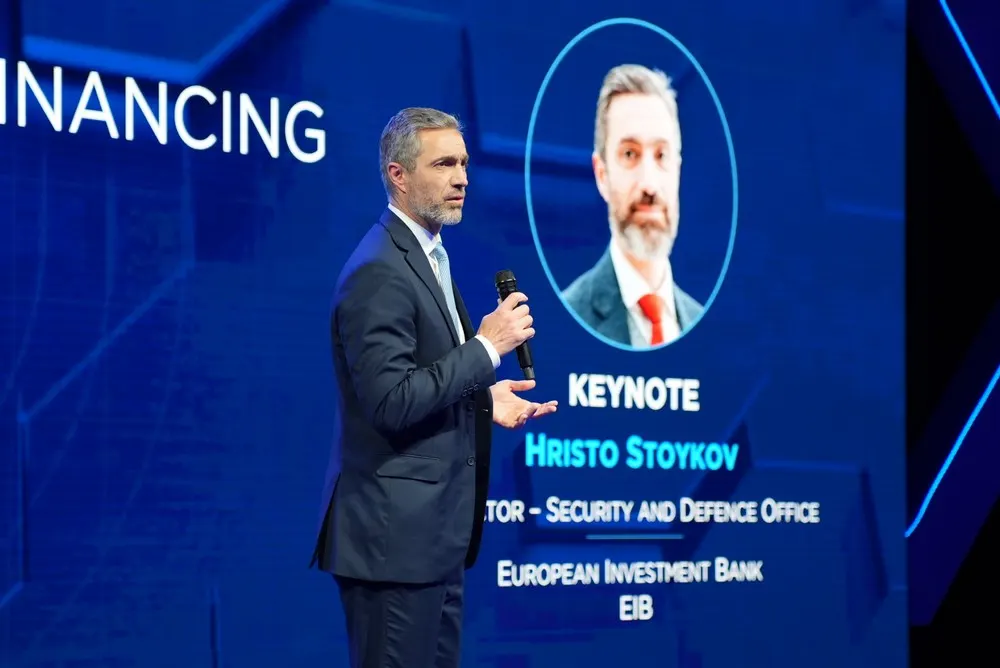
For his part, Hristo Stoykov, Director of the Security and Defence Office at the European Investment Bank (EIB), described how the Bank has become “a much more active player in defence and security financing” over the past two years. It provides loans, guarantees and venture debt for defence, security and dual-use technologies, as well as critical infrastructure and military mobility projects.
Its Security and Defence Office acts as a “one-stop-shop” to help companies, small and medium-sized enterprises and innovators navigate EIB financing. By reducing risk, the Bank also aims to act as a “catalyst for private investment”.
Mr Stoykov advised startups to “Think business as global and scalable. If your solution cannot evolve, you will not survive.” He also cautioned: “Investing in defence is the right and the smart thing to do. But it also asks for keeping the perspective of reality.”
Focus on Luxembourg’s National Defence Fund
Companies also need to identify suitable funding pathways, prepare for investment and understand the challenges they may face as they scale. Dr Ari Kristinn Jónsson of the NATO Innovation Fund warned founders not to delay engaging with end users: “Don't underestimate how hard it is to engage with the end target users, the one that are actually going to be using the products that come from your technology as early as possible.”
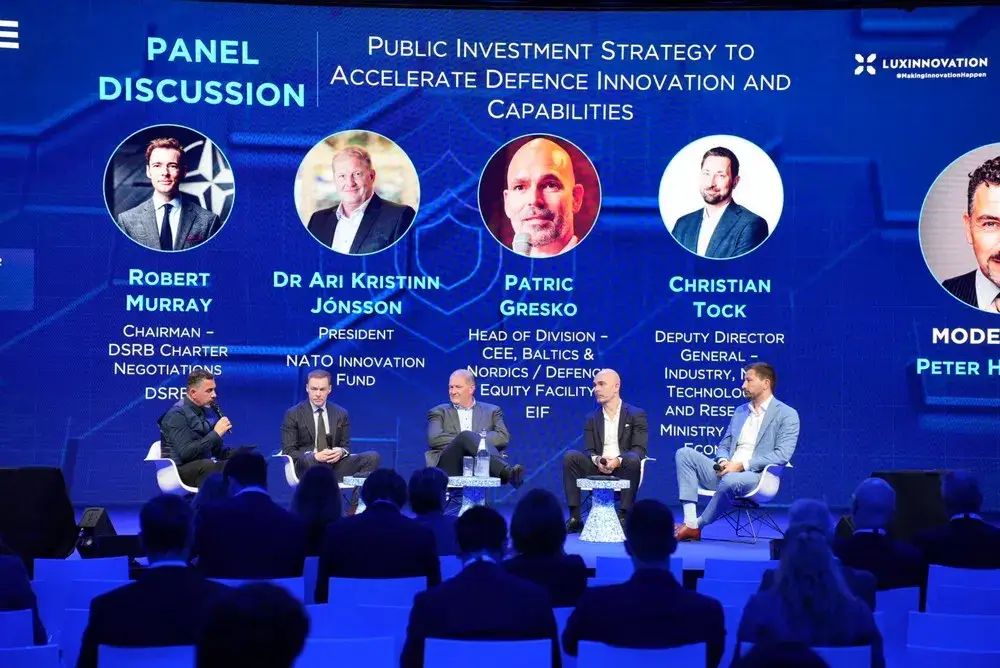
Robert Murray, Chairman of DSRB Charter Negotiations, identified sovereignty as a central priority for the Defence, Security and Resilience Bank (DSRB): “The most important area over the next few years is sovereignty. We need to invest in the technologies that strengthen it, so that nations do not depend entirely on other countries for critical capabilities. That is fundamental.”
Luxembourg’s National Defence Fund is one example of a national financing instrument for innovative defence and dual-use startups. Launched in April 2026 with €150 million and implemented by the Société Nationale de Crédit et d’Investissement (SNCI), it can invest in funds and companies, including in cybersecurity and space, and co-invest alongside eligible funds.
In this context, a valuable piece of advice for companies eligible for this fund is to look beyond the products. “Make sure not to only look at the product, but also build the capacity to keep pace with rapid change,” Christian Tock, Deputy Director General for Industry, New Technologies and Research at Luxembourg’s Ministry of the Economy explained.
Looking beyond the product itself… but also looking beyond immediate funding needs. Patric Gresko, Head of Division for Central and Eastern Europe, the Baltics and the Nordics and Defence Equity Facility at the European Investment Fund (EIF), called for public and institutional investors to mobilise greater resources together. This, he argued, could give European fund managers the capacity to support companies at scale and help them remain competitive and sovereign. “In 2030 I would love a mobilisation of the institution investors alongside the public investors to allow our fund managers having much deeper pockets and finance not against, but alongside the biggest players in the US, and allowing those companies to stay in Europe and allow us to stay sovereign in that sector.”
Connecting European defence investment
Private investors stressed that investment depends on credible routes to adoption. “When we see companies being fully dependent on governments, that's a huge red flag as an investor,” said Jeremy Teboul, Partner at OTB Ventures, while David Dana, Independent Venture Capital and Strategic Advisor at Dana & Co Ventures, highlighted the need for access to customers: “If you don't have access to the military, to the primes, you may be developing something which looks very fancy, very nice, but which has no use and no applications.”
Of course, public institutions also remain vital to the defence and space investment ecosystem. “Without public institutions, there is no ecosystem in space and defence today,” said Thomas Fouquet, General Partner at Karista. Public support can help create the conditions for companies and private investors to participate.
Fragmentation across European defence markets presents another challenge. Luxembourg could contribute to a more connected European investment ecosystem, helping companies and funds collaborate and grow across borders. Nicholas Nelson, Managing Partner at Archangel Capital Partners, said: “The country has the potential to help move beyond national interests and build a truly pan-European ecosystem where companies and funds can establish themselves and grow without being constrained by the geographic-return requirements that have long affected Europe.”
A central role for Luxembourg
It is clear that from public and private investment perspective, financing must match a company’s stage of development, while companies need access to end users, industrial partners and markets. Investment must also build the capacity to adapt as technologies and requirements change.
More and more, Europe’s defence readiness will depend on connecting strategic priorities with investable businesses and reliable demand. Public institutions can establish conditions and share risk. Private investors can provide additional capital and support growth. Companies must show that their solutions meet operational needs and can be delivered at scale.
Luxembourg’s role as a platform for dialogue reflected that shared task. The aim is not simply to finance innovation, but to help turn it into resilient European industrial capacity and deployable capability.