Hallcon: Sustainable hall systems with Fit 4 Sustainability
How Hallcon saves energy, promotes the circular economy and integrates sustainability into the construction of industrial halls through Fit 4 Sustainability..
 Andrea Kuhfuss
08/05/2026
Hallcon is an industrial company based in northern Luxembourg, specialising in the professional construction of industrial halls. The company designs, develops and installs modular hall systems for industrial and commercial clients.
Beyond functionality and quality, issues related to the materials used, energy efficiency and environmental responsibility are now becoming increasingly important, both in its own operations and in the solutions offered to its clients.
Between growth and increasing energy needs
For Gregor Schütz, Managing Partner of Hallcon, the ambition to implement sustainable solutions within the company had been present for a long time. From the outset, he wanted to integrate sustainability as a fully-fledged component of business decision-making, rather than treating it as a separate topic.
“We knew that we wanted to become more sustainable, but we first needed to understand where our main leverage point lay,” he explains.
A presentation of the Fit 4 Sustainability programme by the consultancy Sustain, during an exchange between neighbouring companies, ultimately proved to be the turning point. From the kick-off meeting with the consultants, it quickly became clear that Fit 4 Sustainability offered not only an analysis, but also a structured approach supported by concrete recommendations.
“The explanations showed that this was not just theory, but solutions genuinely suited to our company,” says Mr Schütz.
An in-depth analysis of energy consumption and emissions
As part of the programme, Hallcon benefited from a comprehensive analysis including a carbon footprint assessment and an energy audit (conducted by ID Tech, in collaboration with Sustain). The results confirmed many existing assumptions, while also clearly highlighting for the first time the main source of greenhouse gas emissions: above all, the materials used in projects.
The reliability of the data was decisive: “There were no major surprises, but we finally had confirmation based on clear figures,” explains Mr Schütz.
This transparency provided the basis for targeted investment decisions as part of the transition towards a low-carbon engineering strategy.
Concrete measures focused on energy and the circular economy
The measures implemented focus on three areas: optimisation of production and buildings, mobility, and the decarbonisation of operations. Hallcon has therefore installed a combination of photovoltaic panels, heat pumps and a biomass plant, with the support of public subsidies.
The biomass installation recovers wood waste generated by internal production, in line with the principles of the circular economy.
“Since the wood residues already exist, it makes sense to use them for heating,” explains Mr Schütz.
Alongside the energy-related measures, Hallcon has also introduced organisational changes. A new integrated IT system will in future manage all processes, from purchasing and storage to invoicing. Tasks previously outsourced are now being handled internally, supported by appropriate training and a reorganisation of teams.
Many of these developments could be incorporated into the construction of the new building, which facilitated the transition and enabled more strategic planning.
When environmental challenges become part of client projects
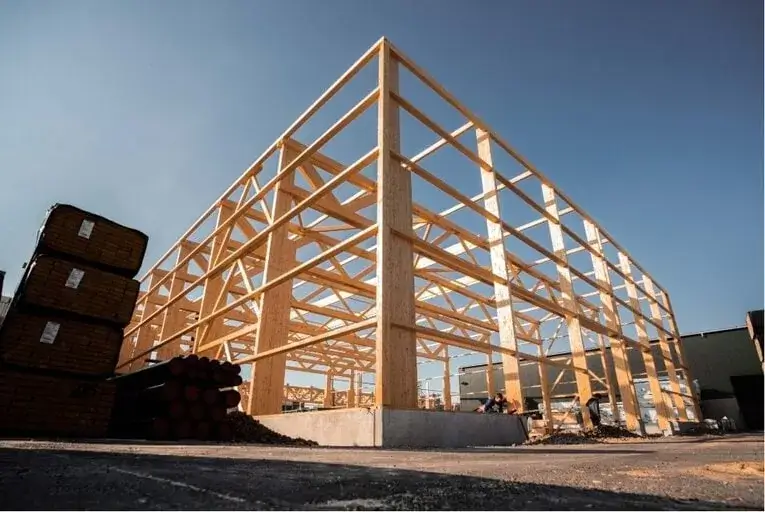
Hallcon is also applying the lessons learned from Fit 4 Sustainability to the solutions it offers its clients. The halls are therefore built using around 90% wood, and photovoltaic installations are now systematically considered in commercial proposals. Clients receive transparent information and can make informed choices between different options.
“We have learned not to think about sustainability solely internally, but to integrate it actively into our offers,” explains Mr Schütz.
This example perfectly illustrates how environmental challenges can be systematically integrated into industrial and commercial processes.
A process focused on the future
In the coming months, Hallcon will complete the construction of its new site, fully commission the new IT systems and continue training its employees.
For Hallcon, Fit 4 Sustainability has proved to be an effective lever for reconciling ecological objectives with operational realities. The programme has helped structure existing ideas, launch targeted investments and make effective use of the available support schemes.
On 21 June, Hallcon will take part in the open day at the Drinklange industrial zone, alongside nine other companies. Visitors will be able to discover various current projects, particularly in the fields of sustainable construction and energy.
Would you like to improve your company’s energy efficiency? Contact Luxinnovation to benefit from personalised support.