
Urban soil restoration with the first Horizon Europe living lab in Luxembourg
The URSOILL project will establish the Luxembourg's most ambitious soil research initiative, with 10 test sites and a transnational network spanning five countries.
 Jean-Michel Gaudron
19/05/2026
Beneath Luxembourg's cities lies a largely invisible crisis. Soil sealing, the progressive covering of land with impermeable surfaces such as roads, car parks and buildings, is estimated to cost the country up to € 220 million per year in lost ecosystem services. Add to that soil contamination and a broad lack of public awareness about soil health: the scale of the challenge becomes clear.
A national challenge with a European response
The URSOILL project (Innovative solutions for sustainable urban soil restoration through urban Living Labs) is the country's direct response. Coordinated by RISE – Research Institutes of Sweden, it is funded under the Horizon Europe EU Mission "A Soil Deal for Europe": a programme designed to mobilise citizens, local authorities and researchers in the transition towards healthy soils by 2030.
URSOILL will establish Luxembourg's first national urban soil living lab funded under the Soil Mission * and connect it to a pan-European network of five living labs operating across Sweden, Spain, Italy and Greece.
The project was officially launched last February and runs to 28 February 2030, with a total budget of EUR 11,999,806.25, of which almost 2 million EUR are allocated to the Luxembourgish partners.
Luxembourg's living lab is coordinated by Luxembourg Institute of Science and Technology (LIST), which leads the coordination at national level and with the other Living Labs of the project, including the scientific framework, soil monitoring analyses.
The other six Luxembourgish partners each bring a distinct and essential contribution:
- Citizens for ecological learning and living (CELL) leads soil literacy, public engagement and community outreach, including work with three community gardens.
- GEOCONSEILS and Interalia contribute expertise in soil pollution, bio-engineering and site-level implementation.
- GEWATEC provides drilling and technical ground intervention capabilities.
- Agora makes two of its former industrial sites (Metzeschmelz in Schifflange and Belval Sud in Esch-sur-Alzette) available for testing and is involved in the solution selection.
- As associated partner, Administration de l'Environnement evaluates the legal applicability of solutions tested on-site and supports regulatory adaptation where needed as well as technical aspects related to soil health.
The Luxembourg consortium operates as part of a broader network of 34 partners coordinated by RISE Research Institutes of Sweden.
 What is a Horizon Europe living lab and why does it matter?
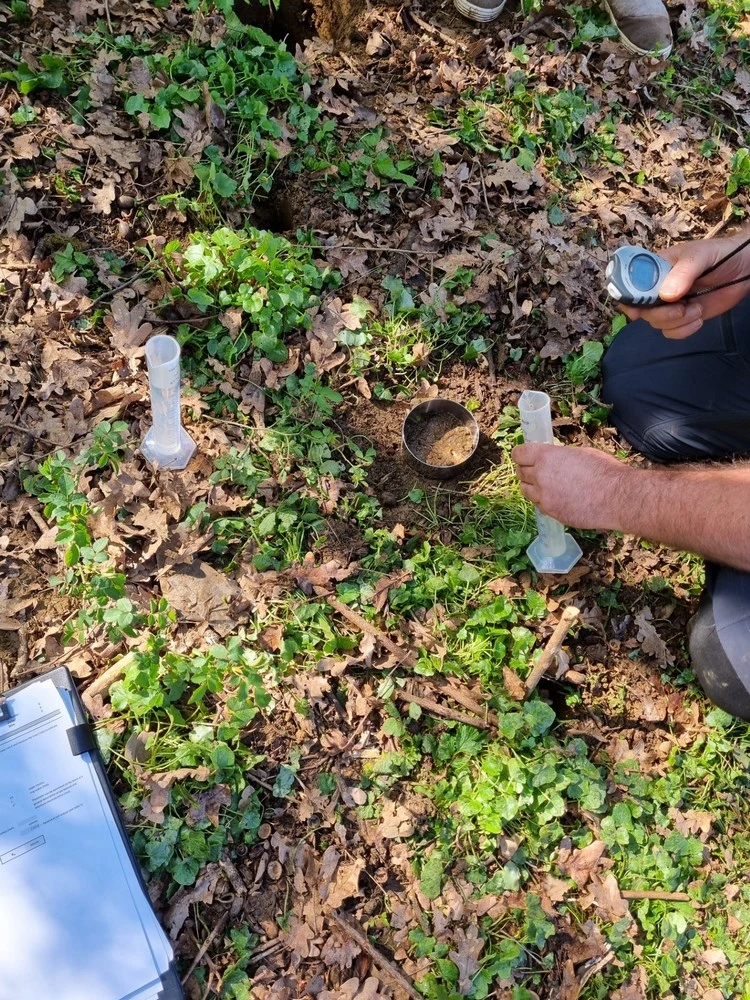
A living lab is not a traditional laboratory. It is a real-world innovation environment where researchers, citizens, companies and public authorities collaborate on actual sites (parks, industrial wastelands, community gardens, car parks) to co-create, test and refine solutions that address concrete societal challenges.
The Horizon Europe work programme that funds URSOILL places living labs at the heart of its methodology precisely because soil restoration cannot happen in isolation. It requires the involvement of those who own the land, those who regulate it, those who live near it and those who study it. This multi-actor, interdisciplinary model is both the scientific approach and the democratic process.
10 sites, 3 challenges, 1 shared ambition
In Luxembourg, the living lab focuses on three core challenges: soil sealing, soil pollution and soil literacy. Ten sites across the Minett region (spanning Differdange, Bettembourg, Sanem, Esch-sur-Alzette, Schifflange and Bascharage) serve as the testing ground.
Techniques to be tested include nature-based solutions (NbS), phytoremediation (using plants to remove or stabilise pollutants), the use of biochar and organic soil improvers, and permeable surface materials designed to improve water infiltration. All interventions will be guided by preliminary soil analyses and assessed for technical feasibility, cost-effectiveness and replicability.
"We want to ensure that the technology we wish to implement is feasible for everyone: for landowners, for soil experts who will need to use it on other sites, for public authorities who will need to approve these new technologies, and for society in general," explains Anna Espinoza, Senior Researcher at LIST and URSOILL contact point for the Urban Living Lab Luxembourg
Luxinnovation's role: from first call to post-award support
Luxinnovation's EU funding team accompanied LIST and its partners throughout the entire lifecycle of the URSOILL proposal, from the earliest stages of idea scoping to post-award implementation.
The engagement began with an information session on the Living Lab calls, co-organised by Luxinnovation and the European Network of Living Labs (ENOLL), during which the specific topic under which URSOILL was ultimately funded was presented. This event brought the opportunity to LIST's attention and helped the team understand the strategic framing of the call.
From there, Luxinnovation participated in preparatory meetings with LIST and the Swedish consortium coordinator to develop the concept and provided concrete recommendations on the legal forms of participation and the budget to request.
Once the project was awarded, the support continued: Luxinnovation organised a dedicated two-hour training on financial reporting for all Luxembourgish partners and also still provides post-award legal and financial guidance to some of the partners.
“This end-to-end accompaniment reflects Luxinnovation's mission as Luxembourg's national contact point for Horizon Europe,” points out Nancy Ramia, PhD, Advisor ‑ European Funding at Luxinnovation. “We are here not only to help organisations identify the right calls, but to support them through every phase of project development and delivery.”
What comes next: open calls and European ambition
URSOILL is still in its early stages as it was officially launched on 10 February 2026, with a co-creation workshop in Belvaux, bringing together approximately 50 professionals, local authority representatives and community garden members from across Luxembourg. A large event gathering participants from all five consortium countries is planned for Luxembourg in October 2026.
In September 2027, the project will launch a single Open Call process to engage in and expand the project LLs by involving new stakeholders such as technology providers and/or site owners to test new solutions in new sites within the LL . These call will be open to local players (research organisations, companies, municipalities and civil society groups) with the aim of widening participation and deepening the innovation ecosystem around urban soil health in Luxembourg.
For Luxembourg, this project marks a significant step: from being a small country grappling with the consequences of rapid urbanisation, to becoming an active contributor to one of Europe's most forward-looking environmental research initiatives.
Interested in Horizon Europe funding?
Whether you are a research organisation, company or public institution based in Luxembourg, Luxinnovation can help you identify the right funding opportunities, build your consortium and prepare a competitive application.
Contact us to find out more about how we support EU-funded projects at every stage, from call identification to post-award management.